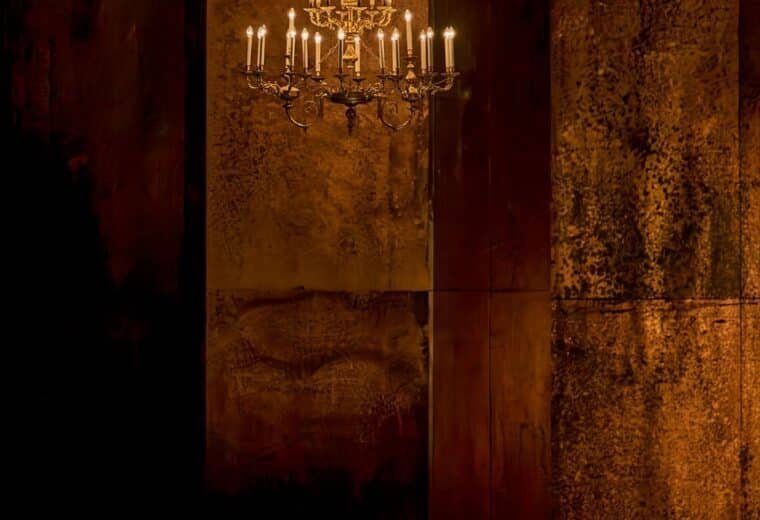
At MusikTheater an der Wien, Philipp Stölzl delivers a theatrically impressive, vocally gripping Flying Dutchman, in which Romanticism is on the stage and not in the pit.
MusikTheater an der Wien — Wednesday 28 October 2026
Orchestra: Wiener Symphoniker
Chorus: Arnold Schoenberg Chor
Conductor: Robert Jindra
Stage director: Philipp Stölzl
Richard Wagner, Der fliegende Holländer, Romantic opera in three acts
The Theater an der Wien, which saw the premiere of the first version of Fidelio, is one of Vienna’s great opera houses. Finding Wagner’s Der fliegende Holländer on the bill of this institution surprised me a little at first, before winning me over for somewhat different reasons: I heard Wagner there without its being quite Wagner. In this production by Philipp Stölzl, with Robert Jindra conducting the Wiener Symphoniker and the excellent Arnold Schoenberg Chor, Romanticism is on the stage and not in the pit. Everything is a matter of transference. This is unquestionably a successful evening: a visually very intelligent production, a cast of the highest quality, but an orchestral account that may prompt a few reservations.
Wagner at twenty-eight
Let us first briefly situate the work, since this is essential before turning to the staging. Wagner was 28 when he composed the opera, at Meudon in the summer of 1841, and it was first performed in Dresden on 2 January 1843. Just before it, Wagner had tried his hand at historical grand opera in the manner of Meyerbeer: that was his Rienzi. With The Flying Dutchman, he returned to the German Romantic imagination, full of the supernatural and of legend. His models are plainly Weber and Marschner, above all Hans Heiling. Wagner first conceived the project for Paris in 1840, and the original version was then reworked, notably for the Dresden premiere. A reminder of the plot: The Flying Dutchman tells the story of a man condemned to roam the seas for all eternity. Every seven years he may come ashore and seek a woman who will swear him absolute fidelity and so set him free. Daland promises him his daughter Senta. Erik, who loves Senta, tries to hold her back. In the end she sacrifices herself. What remains of the work in Stölzl’s staging, which manages to give it the scale of a total spectacle, although that was not yet Wagner’s intention, and which sets painting, theatre, literature and a certain cinematic imagination in rather convincing dialogue?
A Victorian library
Stölzl carries out a genuine displacement. The action no longer unfolds in a Norwegian harbour but in a closed, bourgeois world: that of a Victorian library. Senta first appears as a child, absorbed in a book. Could it be The Memoirs of Herr von Schnabelewopski, the Heine tale from which Wagner drew his subject? The question is worth asking. The library becomes the refuge of a girl trying to escape a stifling, narrow family circle. It is the book that allows her to build a richer world. The book is a way out. The comparison with Emma Bovary suggests itself: the same Romantic temperament, the same dissatisfaction, torn between the ideal and a frustrating reality. But the parallel stops there. Senta’s flight takes place within an oppressive family setting and under a patriarchal, paternal authority that is doubtless castrating and traumatic. The best example is Mary, Senta’s nurse. Stölzl turns her into a governess, or an authoritarian servant, who in one scene tightens the young woman’s corset: an obvious physical rendering of social constraint. The image is not new, as we know. The corset becomes the emblem of a female body that one wishes to silence, to bend to convention and to the dictates of domestic discipline.

A Dutchman born of a book
The Dutchman therefore appears as a pure construct of Senta’s literary imagination: a figure born of the legend she is reading, who little by little eats away at her reality. Romantic drama turns into psychological drama. The whole opera is shown through the prism of Senta’s gaze. From the overture onwards, the library is dominated by a huge painting of a stormy sea. At the end, the painting comes to life. The sailors literally step out of the canvas and come alive. The frame bursts into Senta’s imaginary world, a device not unlike the one Woody Allen used in The Purple Rose of Cairo. Stölzl is clearly steeped in Romantic painting. His staging lets echoes of Friedrich show through, notably in the final tableau, which refers directly and explicitly to Das Eismeer, The Sea of Ice: a shattered ship, blocks of ice. There are echoes of Géricault’s Raft of the Medusa, but also of Peder Balke’s beautiful paintings of the northern lights and Arctic landscapes, or of Frederic Edwin Church for the image of a ship caught in the ice, much like a Senta imprisoned by the bourgeois conventions of her time. Stölzl revives a fantastical, horror-tinged imagination by linking these pictorial references to cinematic echoes of varying taste. At one point, for instance, the Dutchman pierces a globe with his hook, which brings to mind Captain Hook in Peter Pan. The ghostly sailors carry in a chest like the undead of Pirates of the Caribbean. It is effective, but did the fantastic need to be put on display so openly, to the point of losing some of its mystery? Perhaps the imaginary ought to have remained more illustrative.

Where dream becomes space
The second act is undoubtedly the most successful, poised between dream, doubling and mise en abyme. In the Ballad, perfectly shaped in a voice at once powerful and supple, Senta tells the legend of the Dutchman, which lets her project herself into the story. Erik, too, recounts a dream in which he sees his betrothed leave with a stranger. The two characters thus seem imprisoned not by ice but by rival imaginations. Senta is turned towards the Dutchman; Erik senses the catastrophe. Then a painting opens once more onto a harbour, and a double of Senta appears. The Dutchman sings inside a painting that reproduces the drawing room. A second space opens, then another, and in a mirror effect we finally glimpse a drawing room containing an almost cosmic space: stars, furniture floating in the void, a miniature library. The device works very well and, with Senta’s blue dress and her loss of spatial bearings, recalls Alice in Wonderland. This succession of nested worlds finds an echo in the very language of the libretto, since Traum means dream and Raum means space. What the director shows us is the very space of dream and imagination. Here, the dream becomes space…

The hold and the double
Another striking image comes in the third act, when the Dutchman recalls the women who failed to remain faithful to him. These women are shown in the hold of his ship, which becomes a new space of captivity. One must commend the absence of any video here, in favour of genuine live theatre. There is indeed a silent double of Senta, who reproduces exactly the gestures of the Senta in her library. In an age of digital stagings and cinematic effects, such a production cannot fail to win our attention and our sympathy. It is Senta’s imaginary double who sets fire to the hold, in a cathartic, expiatory gesture that frees both the women and the Dutchman. But the real Senta remains a prisoner of reality. She cuts her throat with a shard of glass. The real young woman dies, then, while her double accomplishes the liberating act in a world of fantasy.

A cast led by Ambur Braid
The bloody ending recalls a kind of Lucia di Lammermoor reimagined through the Viennese lens of psychoanalytic hysteria. The staging gives food for thought. First seen in Basel in 2009, it has since been revived in Berlin and Barcelona and has become a classic. The cast is dominated by Ambur Braid, whose stage presence and dramatic commitment carry the performance to its summit. Intensity, acting, power, projection, embodiment: it is all there. Jordan Shanahan’s Dutchman is likewise more than convincing, a figure who asserts a real physical presence within Senta’s paintings. His timbre is dark and firmly anchored. Cameron Becker’s Erik is hampered by a somewhat short top. The character is perhaps less interesting in any case; it is a rather thankless role. Yet he provides a bourgeois counterpoint that is quite essential to Senta’s world of fantasy. The cast as a whole is of excellent and consistent quality: Wilhelm Schwinghammer’s Daland wins every vote, a bass of solidly built sonorities and exemplary diction; James Ley’s very physical Steersman; Ieva Prudnikovaite’s Mary, an excellent actress with a true voice and very secure top notes. The Arnold Schoenberg Chor, a character in its own right, never ceases to impress with its power, by turns terrifying in the ghostly chorus of Act III and heady in the sailors’ revelry. In the pit, Wagner’s score calls for orchestral breadth. But the house, with roughly a thousand seats, is relatively compact, hence the impression of a somewhat dry sound that does not allow the expansiveness one finds on record with Otto Klemperer, and throughout a recorded tradition that has tended to make The Flying Dutchman the first touchstone of the Wagnerian aesthetic. Robert Jindra’s conducting is far from discreditable, even if it sometimes comes across as a little anonymous. It may lack breath, continuity or sweep.

Two ways of hearing one evening
Yet the production as a whole, which enjoys a huge public success, can be read in two different ways. It is as though the staging made up for what the pit does not, and cannot, provide. The stage effects, the doubles, the visual tricks, the metamorphoses and apparitions supply all the Romantic spice that the orchestra withholds. But precisely, the leaner sound of this house allows us to hear a conducting style doubtless more attentive to the voice and less monumental. It is another way of letting Wagner be heard. And this hesitation before the spectacle is, according to the critic Tzvetan Todorov, the very definition of the fantastic, in which one recognises once again the hand of German Romanticism, of duplicity and the double. Which is why my review, too, will waver between immediate enthusiasm for the dramaturgical effectiveness of these devices and questions about the orchestral breadth one might wish for. All the Romanticism of the score thus passes into the theatre and into the voices, into the cast, into a staging of great visual intelligence, even if it is already a few years old, into this dialogue between the arts that amounts to a psychological reading. One will regret the handful of overemphasised fantastical effects.
All in all, and despite some reservations about the conducting, the audience’s triumph does not lie: this is an evening that invites us to think about the music of Der fliegende Holländer more than to live it, but its theatrical vision will haunt us for a long time.