“He wept and loved for all of us” (G. D’Annunzio)
Of Nabucco, almost everything seems to have been said: the audience waits for the famous “Va, pensiero”; it is the patriotic, flamboyant opera everyone loves, but which does not reach the genius of Don Carlos or, later, of an Otello. It is rarer to stress the complexity of the score and the absolute masterstroke that this Verdi opera is. Tonight, at the Grand Théâtre de Genève, thanks to an exceptional cast and a highly stimulating staging, it is indeed the sap and the fire of the Master of Busseto that were honoured, with an Orchestre de la Suisse Romande in great form. The audience’s welcome was warm, enthusiastic and deserved.
A staging at once spare and spectacular
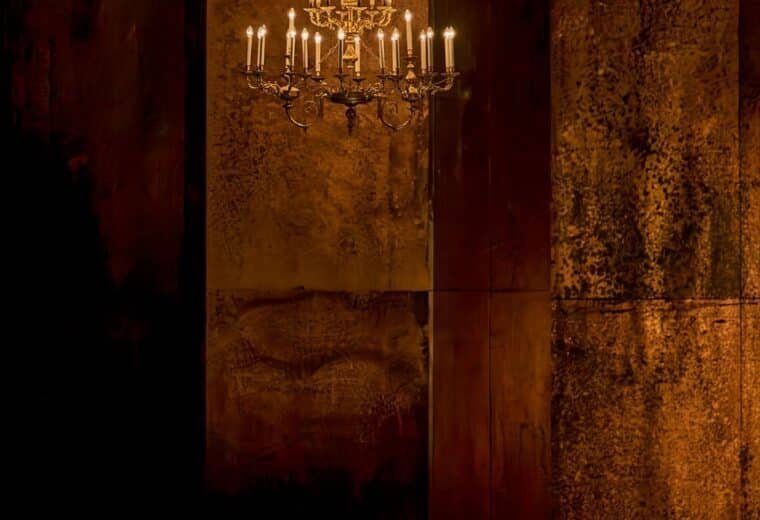
Let us begin, for once, with the staging. Entrusted to Christiane Jatahy, the Brazilian film-maker and writer awarded the Golden Lion of the Venice Biennale in 2022 for her theatrical work as a whole, it is captivating. The close-ups on the soloists, which let us read gazes questioning the timeless arbitrariness of politics and religion; the great mirror held up to the audience, drawing it in even before the curtain rises — a fairly classic post-Brechtian device, abolishing theatrical illusion but of great dramatic effectiveness: this pared-down, spare and yet spectacular staging succeeds in bringing out very beautiful moments of poetry, notably in the first tableau, where water plays a crucial part, but also at the start of the second, when Abigaille discovers that she is in fact only a slave (“Ben io t’invenni, o fatal scritto!”) and the walls fill with the handwriting of the letter, later torn up in front of Nabucco, so that the scraps of paper are then thrown back at the auditorium. Christiane Jatahy uses cameras intelligently (even Nabucco can film his daughter live!): they appear as instruments of surveillance, yet manage to capture the individuality of the suffering of the chorus’s characters. She erases, of course, every historical biblical reference, retaining from the libretto only its philosophical concepts — the struggle against arbitrary power, the necessity of revolution, the exposure of religious fundamentalism. From that point of view it works, even if one may regret the banality of the costumes (except for the play on the exchange of jackets between Nabucco and Abigaille). Special mention for Fenena’s dress, which points to the imprisonment of women’s bodies, the leitmotiv of the production, in a multiplication of that garment which haunts us to the end. What is displayed is the timelessness of fanaticism — not a convenient nod to current affairs but a genuine effort of reflection on the universality and the persistence of evil. One may always wonder about the relevance of modernising certain stagings. I think fine answers are to be found in Daniel Mesguich, the contemporary director, who holds that a staging is like a river feeding other rivers: in other words, the Nabucco of 1842 has since grown, it has been enriched with new meanings, it has become something else — and a staging is by definition perishable: it always tells us where we stand with a work. In the present case one is glad of fine moments, such as scene 2 of the third tableau, where Zaccaria (Riccardo Zanellato, sovereign) sows trouble with his prophecies, prompting the departure of some of the rebellious Hebrews, visibly disinclined to believe the visionary and his predictions. This directorial work deserves praise, all the more so as the music serves it with fluency and harmony.
An Orchestre de la Suisse Romande that reveals the subtlety of a too often misjudged score
Musically, then, it is a fine success. From the overture, with a first theme played legato, then a real force and a galvanising swiftness after the manner of Muti, the conductor Antonino Fogliani — seasoned in the bel canto and Verdi repertoire — chooses to present a score that is airy and subtle, far from the clichés that still sometimes surround this work of early Verdi. We tend to forget that Verdi’s writing, moving gradually away from the stylistic markers of Donizetti and Rossini (even if the Mosè of the Master of Pesaro remains a perceptible model), overcharged and energetic as it sometimes is, full of fire and emphasis (one does not go to war to the sound of triangle and sleigh bells!), knows how to show a lightness, even an intimacy, that Aida will remember. It is precisely this orchestral finesse that Fogliani pursues, revealing the airy clarity of certain almost chamber-scaled passages, and notably the cello, perfectly set off from the opening of the opera to its close. An intimate and moving moment, that poignant memory of happiness sung by Abigaille in scene 1 of the second tableau (what flutes!). Nor does the conductor hold back when it comes to raising the orchestral masses, but he always does so with finesse and reticence, and the Orchestre de la Suisse Romande is always true and precise, in unison with a cast of the most refined.
A cast dominated by Saioa Hernández’s gripping Abigaille
The voices were not to be outdone, ranging from the good (Davide Giusti as Ismaele, a young voice, a physical and dishevelled embodiment, including a fight in the water that glances towards West Side Story!), through the very good (Nicola Alaimo, in a long-awaited first assumption of the role, who makes of Nabucco a physically committed, charismatic figure, with a voice always well placed, a model of diction and of intelligence of the text; Ena Pongrac’s Fenena, fine diction, contained emotion, sobriety, well suited to the part; Riccardo Zanellato’s Zaccaria, hieratic and sovereign), to outright excellence, with a Saioa Hernández who commands the role with ease: she is unquestionably the great Abigaille of our time. She has the necessary high notes, but also the vocal ductility, an evenness from bottom to top (the opening scalette are a model in this respect) and — this is rare — she knows how to hold back, which makes her, above all in the scene where she sings on the floor itself, surrounded by a giant cobweb of a gown, profoundly moving. Undeniably she masters the role, and lets us hear all its strengths and all its fault lines. The human monster. The vocal oxymoron made flesh. A sense of nuance. A complete success. There is something of Turandot in her.
A chorus that gives the evening a cathartic dimension
The evening’s great success was unquestionably the chorus of the Grand Théâtre de Genève, directed by the excellent Alan Woodbridge. One remembers Christiane Jatahy’s excellent idea of repeatedly distributing the choristers through the audience, in the stalls and the balconies, creating not only a striking stereophonic effect but also a form of immersion: breaking the theatrical illusion while paradoxically reconnecting with the function of the chorus in Greek tragedy. The famous “Va, pensiero sull’ali dorate” is thus no longer delivered as an obligatory number (or even a hackneyed warhorse!) but as a real moment of emotion, in which the chorus gives the full measure of its means. I confess to more surprise, and at moments some reserve, about the finale: we know that the opera was to end with the spectacular chorus “Immenso Jehovah”, and that the arrival of a poisoned and dying Abigaille was a request from Strepponi, the future Madame Verdi. Antonino Fogliani chooses to place after the final chorus a symphonic intermezzo of his own composition, while Fenena’s slave dresses file past — music whose modernity may surprise, though it does not entirely disfigure the argument. Then the chorus returns, taking up the “Va, pensiero” again, scattered through the audience and sung a cappella, with the house lights up. Fogliani explains the choice by saying he wanted to build a bridge between the struggles of the Risorgimento and the struggles of our own day. To my mind, the mere repeat of the chorus — already questionable on the score of that famous fidelity to the text — would have been enough to show the universality of the argument. But it must be granted that this surprising finale created an astonishing, grandiose and, let us dare the word, cathartic moment: we are all exiles; we are also suffering humanity, with our wars, our fanaticisms, our drifting nations and our contradictory passions. We weep and we love for all.
All in all, a fine evening, consistent, successful both theatrically and vocally: there is still time to hurry to the Grand Théâtre de Genève and applaud this astonishing production.
NABUCCO at the GRAND THÉÂTRE DE GENÈVE
Opera in four parts by Giuseppe Verdi
Libretto by Temistocle Solera
First performed in 1842 at the Teatro alla Scala, Milan
Last seen at the Grand Théâtre de Genève in 2013–2014
CAST AND CREATIVE TEAM
Conductor Antonino Fogliani
Director Christiane Jatahy
Sets Thomas Walgrave and Marcelo Lipiani
Costumes An D’Huys
Lighting Thomas Walgrave
Video Batman Zavarese
Director of photography and camera (film) Paulo Camacho
Video system development Júlio Parente
Sound artist Pedro Vituri
Dramaturgy Clara Pons
Chorus master Alan Woodbridge
Nabucco Nicola Alaimo
Abigaille Saioa Hernández
Zaccaria Riccardo Zanellato
Ismaele Davide Giusti
Fenena Ena Pongrac
Anna Giulia Bolcato
Abdallo Omar Mancini
Il Gran Sacerdote William Meinert
Chorus of the Grand Théâtre de Genève
Orchestre de la Suisse Romande
A co-production with the Théâtres de la Ville de Luxembourg, Opera Ballet Vlaanderen and the Teatro de la Maestranza, Seville
Read also: VICTORIA HALL / ORCHESTRE DE LA SUISSE ROMANDE / MYUNG-WHUN CHUNG / VERDI REQUIEM