“Adversity is the touchstone of the soul, for it reveals its strength.” (Alessandro Manzoni)
The Messa di Requiem, first performed in 1874 and composed in memory of the poet and novelist Alessandro Manzoni, whom Verdi deeply admired, is – it is a truism – a showpiece of the repertoire, famous for its powerful emotional expressiveness and its dramatic depth, often compared to that of the operas of the master of Busseto. The performance given tonight at the Victoria Hall is one to mark with a white stone, as much for its musical excellence as for the loftiness of view and the emotion released by all the artists, visibly in a state of grace.
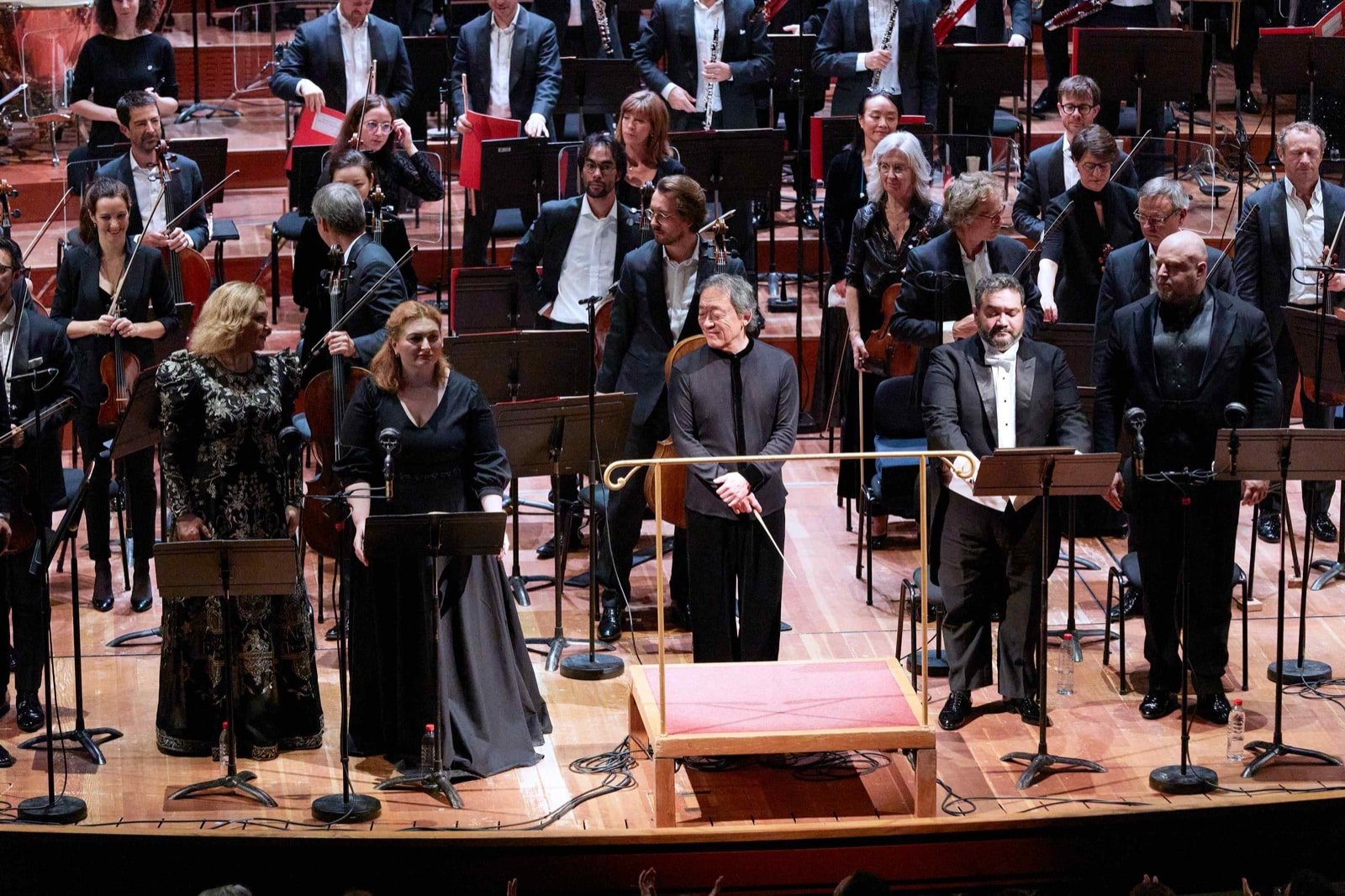
The cello solo, pianissimo, sets the tone of the poignant Requiem e Kyrie, an opening that recalls Schubert’s Unfinished, like a foreshadowing of tragedies to come: we are in mourning for the loss of a great man, but of course the music touches the universal, and that is what the conductor Myung-Whun Chung tells us from the very first bars – sober, concentrated, conducting without a score. This opening, all nuance, serves as prelude to the entry of the Coro dell’Accademia di Santa Cecilia, impeccable from first bar to last, remarkably homogeneous, which with impressive mastery also sets the tone of the evening: between elegiac, modest subtlety and thunderous spectacle. The vocal cast, of the very highest standard, quickly took over, surprising the audience by its homogeneity. Through their powerful account of the Kyrie, the soloists established a dramatic and theatrical frame, underlined by a spectacular Dies Irae that made the hall start (an unleashed percussionist!). Heated white-hot, the Orchestre de la Suisse Romande, with a keen sense of detail and of italianità, contributed to this theatrical atmosphere under the taut, nervous beat of the maestro. The trumpets, strategically placed near the organ, reinforced the impression of a Dantesque tempest, glancing towards the Cypriot spray of Otello while underlining the devastating tsunamis of our tragic history. Taken up as a leitmotiv throughout the work, this Dies Irae is the summit of the Requiem, one of the most dramatic and theatrical pages of the mass, using a wide range of dynamics and orchestral textures to evoke the Last Judgment. Chorus and orchestra interact with an almost palpable energy, underlining the divine power and fury the text evokes. The strokes of the timpani and the blazing brass sharpen this feeling of urgency and sacred terror, making the passage an unforgettable moment of the performance. Paralysing and titanic!
We can only salute the vocal performance of the soloists, all worthy of the highest praise. Ekaterina Semenchuk, already sovereign in the Gurrelieder in Amsterdam last February, expressive and of perfect technique, excels in a Liber scriptus and a Quid sum miser of fine sobriety. Dmitry Belosselskiy (bass) in the Tuba mirum, notably in the pianissimo passages, is sovereign, uniting suppleness and power, depth and flexibility, while asserting the profoundly theatrical character of the work. The Confutatis, followed by a return of the Dies Irae, shows an orchestral mastery that at moments recalls the narrative power of La forza del destino. The orchestra, galvanised, weaves a still more poetic atmosphere in a moving Lacrymosa, whose lyrical echoes may bring to mind great Verdi works such as Nabucco and La traviata. Lyrical expression here reaches a particular, palpable intensity, and touches the heart of the audience directly.
The Offertorio offers a contrast, with a string section whose intonation may seem slightly uncertain at first. The divine passage of the soprano Zarina Abaeva, however, accompanied by a violin solo (Petteri Iivonen, leader of the Paris Opera orchestra, very refined, virtuosic), quickly transforms that opening into a moment of confounding lyrical beauty, culminating in a masterfully executed Hostias. The tenor René Barbera, who is not without a hint of Carlo Bergonzi, offered at that precise instant a moment of grace, sustained by miraculous violins. In the Agnus Dei, Zarina Abaeva once again demonstrates irreproachable technique and an impressive vocal control that enriches this moment of great breadth. The solemnity of her reading, allied to a conducting steeped in fervour, culminates in a gentle passage for the violins, marked by an almost celestial quality. The Lux Aeterna introduces mystical, diaphanous sonorities of a surprisingly Parsifalian cast: unquestionably one of the most beautiful moments of the evening. The Libera me, a genuine anthology piece as much as a showpiece for Zarina Abaeva, gives her the chance to deploy the full extent of her vocal powers, with a powerful dramatisation and bassoons that bring a most welcome sardonic touch. The soprano, evoking both Desdemona and Violetta, gives us a spectacular performance, moving with ease through the low register while displaying a stunning vocal amplitude. This blend of technical mastery and emotional expressiveness confirms her immense talent and helps make this reading of the Requiem a total success.
The performance of Verdi’s Messa da Requiem heard tonight at the Victoria Hall can unquestionably be called one of the most powerful given in recent years: a grandiose evening, made of the tragic and of subtle emotion, distilling the most highly coloured drama as well as the most modest recollection, two authentically Verdian extremes. Without lapsing into an excess of superlatives, it is fair to say that certain moments genuinely took our breath away, in a surge mingling the most delicate poetry with the tragic weight of life. This Geneva Requiem will remain long in the memory.
Read also: Sibelius, Ligeti and Beethoven – Patricia Kopatchinskaja and Hannu Lintu in Geneva · Turnage and Vaughan Williams – Daniel Harding and the Orchestre de la Suisse Romande


