« … it is only the artist who can reconcile the mystic with the rational. »
Leonard Bernstein, Curtis Institute of Music, 1975
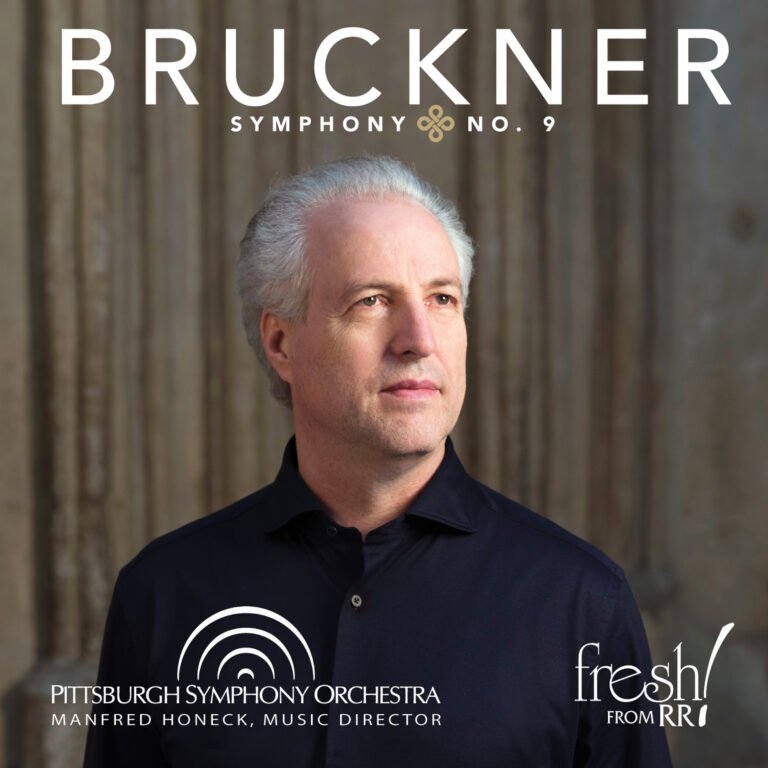
Before the Seventh, there was the Ninth. Recorded live in February 2018, it is the second Bruckner symphony Manfred Honeck committed to disc with Pittsburgh, after the Fourth, and it is a red-letter recording. Honeck knows the score from the inside, because he played it under Bernstein’s baton. In fact, his booklet opens with Bernstein’s own words, quoted above.
We all know the curse of the Ninth, there is no need to recall it here, and this symphony is in fact nearly complete. In the finale, 172 bars are fully orchestrated, the rest is incomplete, and only the coda is missing altogether. We also know that Bruckner wanted his Te Deum to be played in place of the finale, but Honeck does not do so. Completed versions exist, the flashiest, in the best sense of the word, being Rattle’s in Berlin in 2012. Here Honeck chooses tradition. The symphony ends with the Adagio, and we shall see that it stands on its own, and that Honeck convinces us once and for all to choose the unfinished version over any attempt to complete it, just as with Schubert’s Unfinished.
From the very first bars, Honeck makes us feel how new and how strange Bruckner’s musical language is. Already at 2:30 a wave breaks, a drama, with the reverberant sonorities of a cathedral. At 3:00, pizzicati on tiptoe. But the spiritual storm is knocking at the door. There are luminous moments, but they wander, and they mark breathing spaces, the ebb and flow of a tormented consciousness. And yet there are gaps in the clouds, ways out toward blue sky, and one readily imagines the wanderer’s steep climb above a sea of fog. Honeck has a consummate art of silence. This is anxious, questioning music, fearful in places. The storm is never far off. At 7:21, listen to the stopped horns, which I had never heard before, a sardonic, grimacing vision of some inner demon. It takes a recording of great finesse to bring them out like this. This is not the devotional fervor of a Giulini, who remains my absolute favorite, but the questioning of a man in search of an answer, torn between spiritual exercise and the dizzying, Dantesque visions of a pre-Mahlerian purgatorio that foretells the fall of empires and all the tragedies of the twentieth century. It is pictorial. At 11:10, the rallentando. Then the heartbeat of the percussion at 11:20, and the recording is astonishing. Honeck achieves in Bruckner what Abbado achieved in Mahler, the ideal synthesis of substance and form, of the intellectual and the spiritual, of the sensual and the earthly. One feels all the anguish of a thwarted mystic. And yet visions are not lacking, visions in the sense of Rimbaud’s Illuminations, dreamlike architectures unfolding. At last, in the twenty-fourth minute, doors open. If the coda of the first movement makes such an impression, it is through a sense of majesty inexorably bound for a realm beyond symphonic writing itself.
The second movement seems to be the new world, full of sound and fury. Percussion in which every detail can be heard, trombones howling as never before, not unlike the sneering of Mahler’s Seventh. Yet haste, speed and airiness win out. Pizzicati, nothing overdramatized. In the remarkable booklet, Honeck himself acknowledges the fairy-tale, Shakespearean side of the Trio, which would meet the sound world of Strauss’s Till Eulenspiegel. And Honeck’s interpretation catches us off guard by refusing what we sensed coming in the first movement. This is a movement of relative calm, whereas so many conductors tend to look ahead and turn it into pre-Stravinsky. Not at all here. We find again the lightness of Upper Austrian dances. We are very much in Bruckner, and the birth of the new musical world we had imagined should not be overstated.
At last comes the third movement, remarkable from beginning to end. In the fascinating booklet, Honeck draws a textual correspondence with the Agnus Dei of the Catholic Mass, Agnus Dei, qui tollis peccata mundi, miserere nobis. One hears in it the sufferings and sins of the world. It should be heard as a march, what Honeck himself calls a Passion March, after the torments of metaphysical questioning. We are still in the world of Caspar David Friedrich. These are perhaps the last fires of the great Romantic symphony, and on the personal as on the musical level, it is a testament. In the seventeenth minute comes what Manfred Honeck rightly calls one of the most beautiful moments in music. The superlative violins create an effect that looks toward Vaughan Williams’s Fantasia on a Theme by Thomas Tallis. In other words, a last gleam of the setting sun, a dust of light shimmering on cathedral stained glass. It is divine. At 22:47 comes what Honeck calls an emotional earthquake, coupled with unheard-of harmonic daring. Here is the new world. A long silence follows. Has such a passage ever been heard in a Bruckner Ninth? The last bars arrive and the answer is given. There is indeed a new world, one that opens inward. Its gaze is turned toward a horizon tempered by the shimmering images of twilight stained glass.
Once again, the booklet written by Honeck is exceptional. And once again, the Soundmirror team, with producer Dirk Sobotka and engineer Mark Donahue, has done outstanding work, refining the final balance in long listening sessions with Honeck and the musicians.