« A balance must be found in honoring the expressive intent hidden within the musical text rather than merely focusing on pure execution. »
(Manfred Honeck)
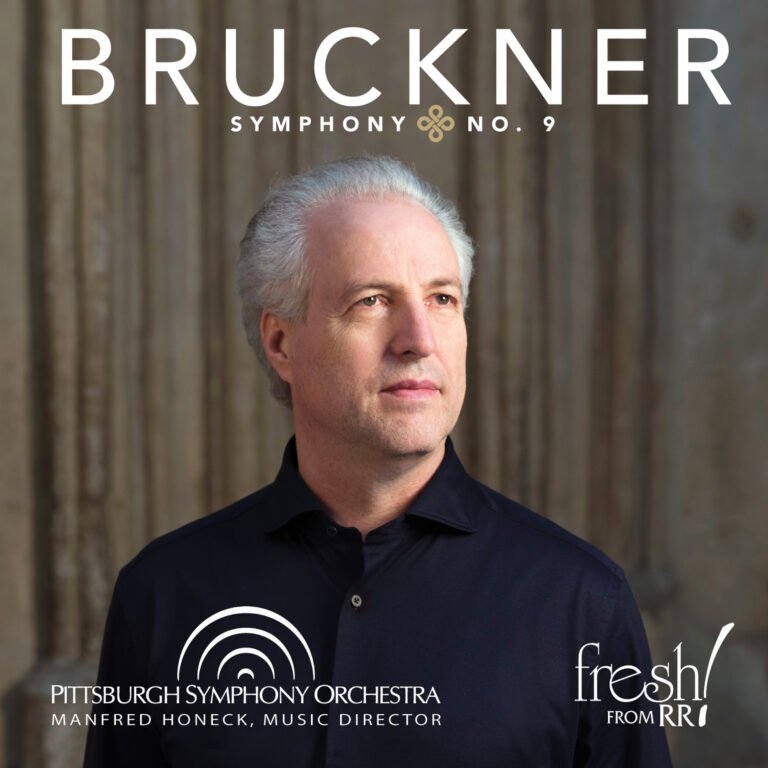
Manfred Honeck is surely one of the great Brucknerians of our time, worthy of a place beside Jochum, with a gift for synthesis that is all his own. The first movement opens in breadth and then, almost at once, draws back into reticence. That intention is borne out by Honeck’s excellent booklet, which asks whether Bruckner is a spiritual composer or an intellectual one and shows that he cannot be reduced to either. There is spirit, there is soul, and there is body, hence the feeling of completeness, of synthesis, of a world enlarged.
Looking back on his years in the Vienna Philharmonic, Honeck confesses to being torn between two ways of hearing the Seventh, as a work that stands on its own and as one that needs Bruckner’s life to be understood, and he declines to choose. The devout organist of St. Florian and Linz Cathedral, the gifted improviser, the man raised on Upper Austrian folk music and in awe of Wagner all pass into this symphony, whose spirituality deepens with the death of Wagner, mourned by the Wagner tubas.
The twenty-one minutes of the first movement go by surprisingly fast, and there is not a dull moment. Everything feels inevitable, sometimes to the point of being predictable, and the pianissimi show how much Honeck owes to Claudio Abbado, whose assistant he once was. Schubert is never far away, and it seems fitting that the December 1884 premiere shared its program with Liszt’s Les Préludes and Schubert’s Wanderer Fantasy. Honeck wants the movement to have its breadth and majesty and its spiritual weight, of course, but some passages are played like a Hungarian dance, and he is right. Later one hears, and feels, the mystery of the Mass, the Consecration, contemplation. The coda, with its echoes of Das Rheingold, its mountain landscapes and its folk accents, gathers up the whole Brucknerian spirit.
The Adagio is a farewell to life, tender and melancholy, close in feeling to Schubert’s symphonies. Honeck argues that this music is too often taken too fast and allows himself to slow down, which Bruckner would hardly have objected to, since he himself admitted that he had probably chosen too fast a tempo. His Adagio lasts twenty-two and a half minutes. The key, for Honeck, lies in markings such as feierlich and misterioso, which he reads as concealed tempo indications rather than indications of mood, and from there he makes the case for a certain freedom with tempo. It all comes back to balance, between absolute respect for the text and the search for what lies hidden behind it. As Bruckner himself said, a great many things are not written in the score. The movement also carries echoes of the Te Deum, which he was writing at the same time.
The third movement stands out. Honeck brings back the « mocking bird » that Bruckner wrote into the score at bar 137, a marking dropped from the early editions. The music takes on a pastoral, almost Beethovenian air, with clarinet playing for the ages, never heard like this before, the clarinets calling like a cuckoo.
The finale, true to that total vision of Bruckner’s world, brings out the purity of Alpine nature and the melancholy of the Wagner tubas, which sound here like alphorns. Honeck calls this movement a true masterpiece of compositional art, and one could hardly put it better. Then there is the sound itself, the power of the brass outbursts. This American orchestra holds its own with the great European bands, with a truly Brucknerian sonority and none of the brass glare of Chicago. Extraordinary. A tour de force.
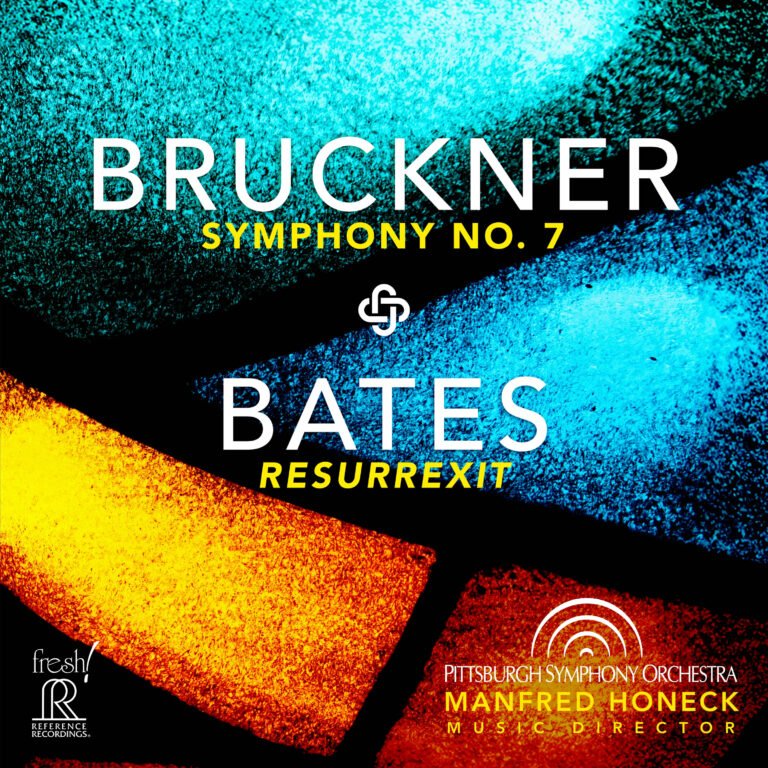
Bates’s Resurrexit, written in 2018 for the maestro’s sixtieth birthday, fills out the disc. It is an engaging piece, with a few glints of Boléro, the pentatonic scale of Debussy’s orientalism, echoes of the Middle East. It is tonal, very close to film music, and it ends in spectacle, in the manner of Copland or John Williams, in glorious triumph.
The Soundmirror team has done an exceptional job. Honeck admits that a single note can annoy him for weeks. So several concerts are recorded, then edited with relentless care. And the resulting disc is truly remarkable from start to finish.